
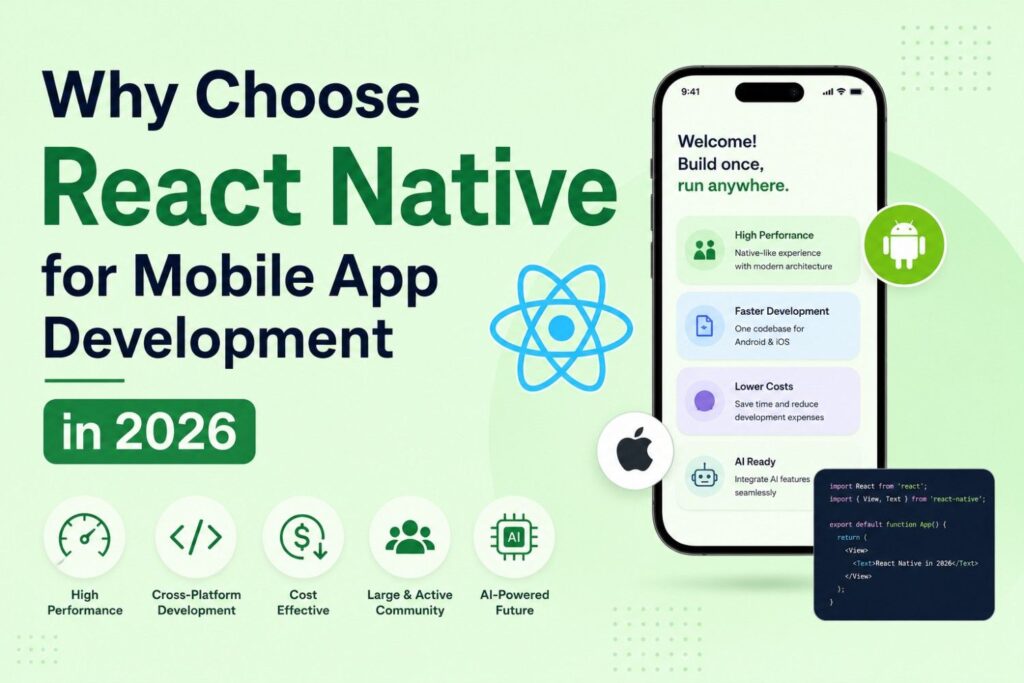
Building a mobile application in 2026 isn’t just about launching on Android and iOS. Businesses now expect faster development, lower costs, AI-powered experiences, scalable architecture, and a native-quality user experience.
This is where React Native continues to stand out.
Originally developed by Meta, React Native has evolved into one of the most mature cross-platform frameworks available today. Thanks to the New Architecture, Fabric Renderer, TurboModules, and the JavaScript Interface (JSI), it delivers better performance than ever before.
Whether you’re building an MVP, SaaS application, eCommerce platform, healthcare app, fintech solution, or enterprise product, React Native remains a smart investment in 2026.
What Is React Native?
React Native is an open-source cross-platform mobile application framework created by Meta that enables developers to build native Android and iOS applications using JavaScript, React, and increasingly TypeScript.
Unlike traditional hybrid frameworks that render applications inside a WebView, React Native communicates directly with native platform components. This allows developers to create applications that look and behave like native apps while sharing much of the codebase across both platforms.
Instead of maintaining separate projects using Kotlin for Android and Swift for iOS, development teams can reuse approximately 80–90% of their application code, depending on project requirements. The result is faster development, easier maintenance, and a more consistent experience across devices.
React Native also integrates smoothly with modern backend technologies and cloud platforms, including:
- Laravel
- Node.js
- ASP.NET Core
- Django
- Spring Boot
- Firebase
- Supabase
- AWS
- Microsoft Azure
- Google Cloud
Whether your application relies on REST APIs, GraphQL, WebSockets, or real-time databases, React Native offers the flexibility to integrate with virtually any modern backend architecture.
How React Native Has Evolved
One of the biggest misconceptions about React Native is that it’s the same framework it was five years ago.
In reality, React Native has undergone significant architectural improvements that have transformed its performance, scalability, and developer experience.
The Old Bridge Architecture
Earlier versions relied on a communication layer known as the JavaScript Bridge, which acted as an intermediary between JavaScript code and native platform APIs. While this approach enabled cross-platform development, it could become a bottleneck for applications requiring frequent communication between JavaScript and native modules.
For data-heavy interfaces, complex animations, or real-time interactions, the bridge occasionally introduced latency that affected responsiveness.
The New Architecture
Modern React Native replaces many of these limitations with a redesigned architecture focused on performance and efficiency.
Key improvements include:
Hermes JavaScript Engine
Hermes is an optimized JavaScript engine designed specifically for React Native applications. It improves application startup times, reduces memory consumption, decreases app size, and delivers more predictable runtime performance, particularly on lower-powered devices.
Fabric Renderer
Fabric is React Native’s new rendering system. It enables faster UI updates, smoother animations, and improved synchronization between JavaScript and native views, helping applications feel more responsive and closer to fully native experiences.
TurboModules
TurboModules replace the legacy module system with a more efficient architecture that loads native functionality only when required. This reduces startup overhead while improving communication between JavaScript and native code.
JavaScript Interface (JSI)
The JavaScript Interface (JSI) removes many of the performance limitations associated with the old bridge by enabling direct interaction between JavaScript and native components. This significantly reduces latency and improves overall responsiveness.
Better TypeScript Support
As TypeScript adoption continues to grow, React Native has become increasingly developer-friendly with improved typing, tooling, IDE support, and safer large-scale application development.
Together, these improvements make React Native faster, more reliable, and better equipped to support modern mobile applications than ever before.
Why Businesses Choose React Native in 2026
Technology decisions aren’t based solely on technical specifications—they’re driven by business outcomes. Companies need solutions that reduce costs, accelerate delivery, simplify maintenance, and support long-term growth.
Here are the biggest reasons organizations continue choosing React Native.
1. One Codebase for Android and iOS
Maintaining separate Android and iOS applications means duplicated effort across development, testing, debugging, and feature updates.
React Native dramatically simplifies this process by allowing teams to share most of the application’s business logic and UI components.
Benefits include:
- Faster feature releases
- Consistent user experience
- Lower maintenance costs
- Easier bug fixes
- Simplified QA testing
- Faster onboarding for developers
For startups and businesses with limited engineering resources, this shared-code approach can significantly reduce project complexity.
2. Faster Time-to-Market
Speed is often the difference between leading the market and falling behind competitors.
React Native accelerates development through reusable components, Fast Refresh, mature development tools, and an extensive package ecosystem. Teams can prototype, test, and launch products much faster than maintaining separate native applications.
This makes React Native particularly valuable for:
- MVP development
- Startup launches
- Product validation
- Feature experimentation
- Agile development teams
Launching earlier allows businesses to gather user feedback, validate assumptions, and iterate more quickly.
3. Lower Development Costs
Building separate native applications typically requires two specialized teams, increasing both development and long-term maintenance expenses.
With React Native, organizations benefit from:
- Shared development effort
- Unified testing processes
- Single codebase maintenance
- Faster updates
- Reduced infrastructure costs
While complex applications may still require some platform-specific code, the overall total cost of ownership is often considerably lower than maintaining independent Android and iOS projects.
4. Near-Native Performance That Meets Modern Expectations
One of the biggest criticisms of React Native in its early years was performance. While it was always suitable for many business applications, complex animations, large datasets, and real-time interactions could expose the limitations of its older architecture.
In 2026, that perception is outdated.
Thanks to the Hermes JavaScript Engine, Fabric Renderer, TurboModules, and the JavaScript Interface (JSI), React Native delivers significantly better startup times, smoother rendering, and more efficient communication between JavaScript and native components.
For most business applications including eCommerce, healthcare, banking, logistics, and social platforms users are unlikely to notice a difference between a well-built React Native app and a fully native one.
Key Performance Improvements
Modern React Native applications benefit from:
- Faster application launch times
- Reduced memory usage
- Smoother scrolling and animations
- Better responsiveness during heavy workloads
- Faster communication with native APIs
- Improved rendering for complex interfaces
- Better battery efficiency on supported devices
When paired with good coding practices, optimized images, lazy loading, and efficient state management, React Native can comfortably support applications with hundreds of thousands—or even millions—of users.
5. Easy AI Integration for Modern Mobile Apps
Artificial Intelligence is no longer an optional feature. From personalized shopping experiences to intelligent customer support, AI is reshaping how users interact with mobile applications.
React Native provides an excellent foundation for building AI-powered experiences because it integrates easily with cloud-based AI services and machine learning APIs.
Businesses can implement features such as:
- AI chat assistants
- Smart search
- Personalized recommendations
- Voice assistants
- OCR (Optical Character Recognition)
- Language translation
- Document analysis
- Image recognition
- AI-generated content
- Predictive analytics
Developers commonly integrate React Native applications with platforms such as:
- OpenAI
- Google Gemini
- Anthropic Claude
- Azure AI Services
- AWS AI Services
- Google Cloud Vertex AI
These integrations make it possible to deliver intelligent features without building complex machine learning models from scratch.
For example, an eCommerce app can recommend products based on browsing history, while a healthcare application can summarize patient information using an AI assistant. Similarly, logistics companies can use predictive analytics to optimize delivery routes, and educational platforms can offer personalized learning experiences.
6. An Extensive Ecosystem That Accelerates Development
Choosing a framework isn’t just about its core capabilities it’s also about the ecosystem surrounding it.
React Native benefits from one of the largest developer communities in the world, which means access to thousands of maintained libraries, plugins, and tools.
Popular technologies within the React Native ecosystem include:
- Expo
- React Native CLI
- Metro Bundler
- React Navigation
- React Hook Form
- TanStack Query (React Query)
- Redux Toolkit
- Zustand
- Axios
- Reanimated
- Gesture Handler
- Firebase
- Supabase
- Stripe SDK
Instead of building common functionality from scratch, developers can leverage these mature tools to add authentication, payments, navigation, animations, push notifications, and offline capabilities more efficiently.
This reduces development time while improving overall application quality.
7. Easy Integration with Modern Backend Technologies
A mobile application is only as powerful as the backend that supports it.
React Native is backend-agnostic, meaning it works seamlessly with virtually any modern server-side technology.
Common backend stacks include:
- Laravel
- Node.js
- ASP.NET Core
- Django
- Spring Boot
- Ruby on Rails
It also integrates effortlessly with services such as:
- Firebase
- Supabase
- REST APIs
- GraphQL
- WebSockets
- PostgreSQL
- MySQL
- MongoDB
This flexibility allows businesses to use existing infrastructure without rebuilding backend systems.
For example:
- A Laravel-based CRM can expose REST APIs that power a React Native mobile application.
- A Node.js backend can deliver real-time chat using WebSockets.
- Firebase can handle authentication, push notifications, analytics, and cloud storage for startups looking to launch quickly.
8. Enterprise-Ready Security Features
Security is a top priority for organizations handling customer information, financial transactions, or sensitive business data.
React Native supports enterprise-grade security practices when implemented correctly.
Some commonly used security features include:
- OAuth 2.0 authentication
- JWT-based authorization
- Biometric authentication using Face ID and fingerprint recognition
- Secure token storage
- End-to-end encryption
- SSL pinning
- Secure API communication
- Multi-factor authentication (MFA)
Combined with secure backend practices and regular security testing, React Native applications can meet the requirements of industries such as healthcare, banking, insurance, and government services.
9. Easier Maintenance and Long-Term Scalability
As applications grow, maintaining multiple codebases becomes increasingly difficult. Every new feature, bug fix, or security update must be implemented separately for Android and iOS, increasing both cost and complexity.
React Native simplifies long-term maintenance by allowing teams to manage most of the application from a single codebase.
Advantages include:
- Centralized updates
- Shared business logic
- Reusable UI components
- Faster debugging
- Simplified quality assurance
- Consistent feature rollouts across platforms
This approach enables businesses to respond more quickly to customer feedback and market changes without significantly increasing development overhead.
10. Ideal for Startups, SMEs, and Enterprises
React Native isn’t just for startups—it has matured into a framework suitable for organizations of all sizes.
Startups
For startups, React Native enables rapid MVP development, helping founders validate ideas before investing heavily in separate native applications.
Small and Medium Businesses
SMEs benefit from lower development costs, faster release cycles, and simplified maintenance, making React Native an excellent choice for digital transformation initiatives.
Enterprise Organizations
Large enterprises often use React Native to modernize customer-facing applications, employee portals, internal dashboards, and field-service solutions while maintaining consistent experiences across multiple platforms.
Because of its scalability and mature ecosystem, React Native can support both early-stage products and enterprise-grade applications with complex business requirements.
Companies Using React Native
The framework’s adoption by globally recognized organizations demonstrates its reliability at scale.
Some notable companies that have incorporated React Native into their mobile development strategy include:
- Meta
- Shopify
- Discord
- Microsoft
- Wix
- Coinbase
- Bloomberg
These organizations serve millions of users worldwide, proving that React Native is capable of powering high-performance, production-grade mobile applications across diverse industries.
React Native vs Flutter: Which Framework Should You Choose?
When evaluating cross-platform mobile development, the comparison between React Native and Flutter is unavoidable. Both frameworks allow developers to build Android and iOS apps from a single codebase, but they differ in architecture, programming language, ecosystem, and long-term flexibility.
React Native is powered by JavaScript and TypeScript, making it a natural choice for teams already using React for web development. Flutter, developed by Google, uses the Dart programming language and renders its own UI components instead of relying on native platform widgets.
Neither framework is universally better the right choice depends on your team’s expertise, project requirements, and business goals.
| Feature | React Native | Flutter |
|---|---|---|
| Developed By | Meta | |
| Programming Language | JavaScript / TypeScript | Dart |
| UI Rendering | Native Components | Custom Rendering Engine (Skia) |
| Learning Curve | Easier for React Developers | Moderate |
| Community Size | Very Large | Large and Growing |
| Package Ecosystem | Mature | Extensive |
| Performance | Near Native | Near Native |
| Code Reusability | High | High |
| Web Development Synergy | Excellent | Limited |
| Best For | Business Apps, SaaS, Enterprise, MVPs | Highly Customized UI, Graphics-Heavy Apps |
Choose React Native if:
- Your team already works with React.
- You want faster onboarding for developers.
- You need a mature ecosystem with extensive third-party libraries.
- Your business has both a web application and a mobile app, allowing code and knowledge sharing across teams.
- Speed to market and long-term maintainability are top priorities.
Choose Flutter if:
- Your application requires highly customized user interfaces.
- You’re building animation-heavy experiences.
- Your team is comfortable adopting Dart.
- Visual consistency across all platforms is more important than using native UI components.
For the majority of business applications, both frameworks perform exceptionally well. However, React Native often has an advantage for organizations already invested in the JavaScript ecosystem.
React Native vs Native Development
Cross-platform frameworks have improved dramatically, but native development still has its place.
Native Android applications are built using Kotlin, while native iOS applications are developed using Swift and SwiftUI. These technologies provide direct access to platform APIs and allow developers to optimize applications for specific operating systems.
The trade-off is increased cost and longer development timelines because Android and iOS require separate codebases.
React Native is the Better Choice When:
- You need both Android and iOS apps.
- Budget is a major consideration.
- Time-to-market is critical.
- Features are largely the same across platforms.
- You want easier long-term maintenance.
Native Development is the Better Choice When:
- Building AAA mobile games.
- Developing advanced AR or VR applications.
- Creating graphics-intensive software.
- Accessing low-level hardware features.
- Optimizing every aspect of performance for a single platform.
For most startups, SaaS companies, eCommerce businesses, healthcare providers, and enterprise applications, React Native provides more than enough performance while significantly reducing development costs.
Best Use Cases for React Native
React Native’s flexibility makes it suitable for a wide variety of industries and business models.
eCommerce Applications
Modern eCommerce apps require features such as secure payments, product catalogs, order tracking, push notifications, wishlists, and personalized recommendations.
React Native integrates easily with payment gateways like Stripe, analytics platforms, inventory systems, and AI recommendation engines, making it an excellent choice for online retailers.
Healthcare Applications
Healthcare providers increasingly rely on mobile applications for:
- Telemedicine
- Appointment scheduling
- Electronic Health Record (EHR) access
- Medication reminders
- Patient portals
- Remote monitoring
React Native supports secure authentication, biometric login, encrypted communication, and HIPAA-friendly backend integrations when implemented correctly.
FinTech Applications
Financial applications demand reliability and strong security.
React Native can support:
- Mobile banking
- Digital wallets
- Investment platforms
- Expense tracking
- Budget management
- Cryptocurrency applications
By integrating with secure APIs, biometric authentication, and encrypted storage, businesses can build trustworthy financial solutions.
SaaS Platforms
Many Software-as-a-Service companies build companion mobile apps that allow users to manage projects, communicate with teams, or monitor business performance on the go.
React Native works particularly well with SaaS platforms powered by Laravel, Node.js, or ASP.NET Core.
Logistics and Delivery
Businesses involved in transportation and logistics often require:
- GPS tracking
- Route optimization
- Driver management
- Barcode scanning
- Proof of delivery
- Real-time notifications
React Native integrates with mapping services, geolocation APIs, and WebSockets to support these capabilities efficiently.
Education Platforms
Educational apps commonly include:
- Video lessons
- Interactive quizzes
- Live classes
- Progress tracking
- AI tutoring
- Offline learning
React Native’s support for multimedia, offline storage, and cloud synchronization makes it well-suited for modern eLearning solutions.
How Much Does React Native Development Cost?
One of the strongest business advantages of React Native is its ability to reduce overall development expenses.
Instead of maintaining separate Android and iOS teams, businesses can invest in a shared codebase that supports both platforms.
While the exact cost depends on project complexity, typical ranges are:
| Project Type | Estimated Timeline |
|---|---|
| MVP | 2–4 Months |
| Medium Business App | 4–8 Months |
| Enterprise Application | 8–12+ Months |
Factors influencing development costs include:
- UI complexity
- Third-party integrations
- AI features
- Real-time functionality
- Offline capabilities
- Security requirements
- Backend infrastructure
- Testing and quality assurance
Although native development may still be necessary for certain specialized applications, React Native often delivers a lower total cost of ownership through shared development, simplified maintenance, and faster feature releases.
When React Native Isn’t the Right Choice
No technology is perfect for every project.
While React Native excels in most business applications, there are situations where native development remains the better option.
Consider native development if your application requires:
- High-end 3D gaming
- Advanced augmented reality (AR)
- Virtual reality (VR)
- Complex graphics rendering
- Low-level hardware programming
- Specialized embedded device communication
These applications often require platform-specific optimizations that are easier to achieve with Kotlin or Swift.
Recognizing these limitations helps businesses choose the right technology from the beginning instead of forcing an unsuitable framework into a specialized use case.
Is React Native Future Proof?
Everything suggests that React Native will remain a major player in mobile development for years to come.
Several factors support its long-term future:
- Continued investment from Meta.
- A large global open-source community.
- Strong adoption by startups and enterprises.
- Continuous performance improvements through the New Architecture.
- Growing TypeScript adoption.
- Excellent compatibility with AI-powered applications.
- Expanding Expo ecosystem.
- Regular support for the latest Android and iOS releases.
As businesses continue seeking faster development cycles, lower costs, and cross-platform consistency, React Native is well-positioned to remain one of the leading mobile development frameworks.
Final Thoughts
Choosing the right mobile framework is about balancing performance, scalability, cost, and long-term maintainability. In 2026, React Native successfully delivers on all four.
Its modern architecture, mature ecosystem, and strong support for Android and iOS development enable businesses to launch high-quality applications without maintaining separate codebases. Whether you’re building an MVP, scaling a SaaS platform, modernizing enterprise software, or integrating AI-powered features, React Native offers a practical and future-ready foundation.
While native development still makes sense for graphics-intensive or hardware-specific applications, React Native has reached a level of maturity where it can confidently support the vast majority of commercial mobile apps. For organizations looking to accelerate development while controlling costs, it remains one of the smartest technology choices available.
Frequently Asked Questions
1. Is React Native still worth using in 2026?
Yes. React Native continues to evolve with improvements like the New Architecture, Hermes, Fabric, and TurboModules, making it one of the most capable cross-platform frameworks available.
2. Is React Native better than Flutter?
Both are excellent frameworks. React Native is often the preferred choice for teams already using React and JavaScript, while Flutter is well suited for highly customized user interfaces. The best option depends on your project requirements and development expertise.
3. Can React Native build enterprise applications?
Absolutely. Many enterprise organizations use React Native for customer apps, employee portals, field-service solutions, and internal business platforms thanks to its scalability and maintainability.
4. Does React Native support AI features?
Yes. React Native integrates with services like OpenAI, Google Gemini, Anthropic Claude, Azure AI, and AWS AI, enabling features such as chatbots, voice assistants, OCR, recommendations, and intelligent search.
5. Can React Native work with Laravel?
Yes. Laravel is one of the most popular backend frameworks used with React Native. Applications typically communicate through REST APIs or GraphQL, making it a powerful combination for scalable mobile solutions.
6. Is React Native secure?
React Native supports secure authentication, encrypted storage, biometric login, SSL pinning, OAuth, and JWT-based authorization. When paired with secure backend practices, it is suitable for industries with strict security requirements.
7. How much code can be shared between Android and iOS?
Most React Native projects share around 80–90% of their codebase. The exact percentage depends on platform-specific features and integrations.
8. Can React Native apps be published on the App Store and Google Play?
Yes. React Native applications compile into native apps that can be distributed through both the Apple App Store and Google Play Store, following each platform’s submission guidelines.
9. Is Expo required to use React Native?
No. Expo simplifies development and provides many built-in tools, but developers can also use the React Native CLI for projects requiring deeper native customization.
10. Is React Native a good choice for startups?
Yes. React Native is ideal for startups because it enables faster development, lower costs, and shorter time-to-market, making it easier to validate ideas and scale products as the business grows.