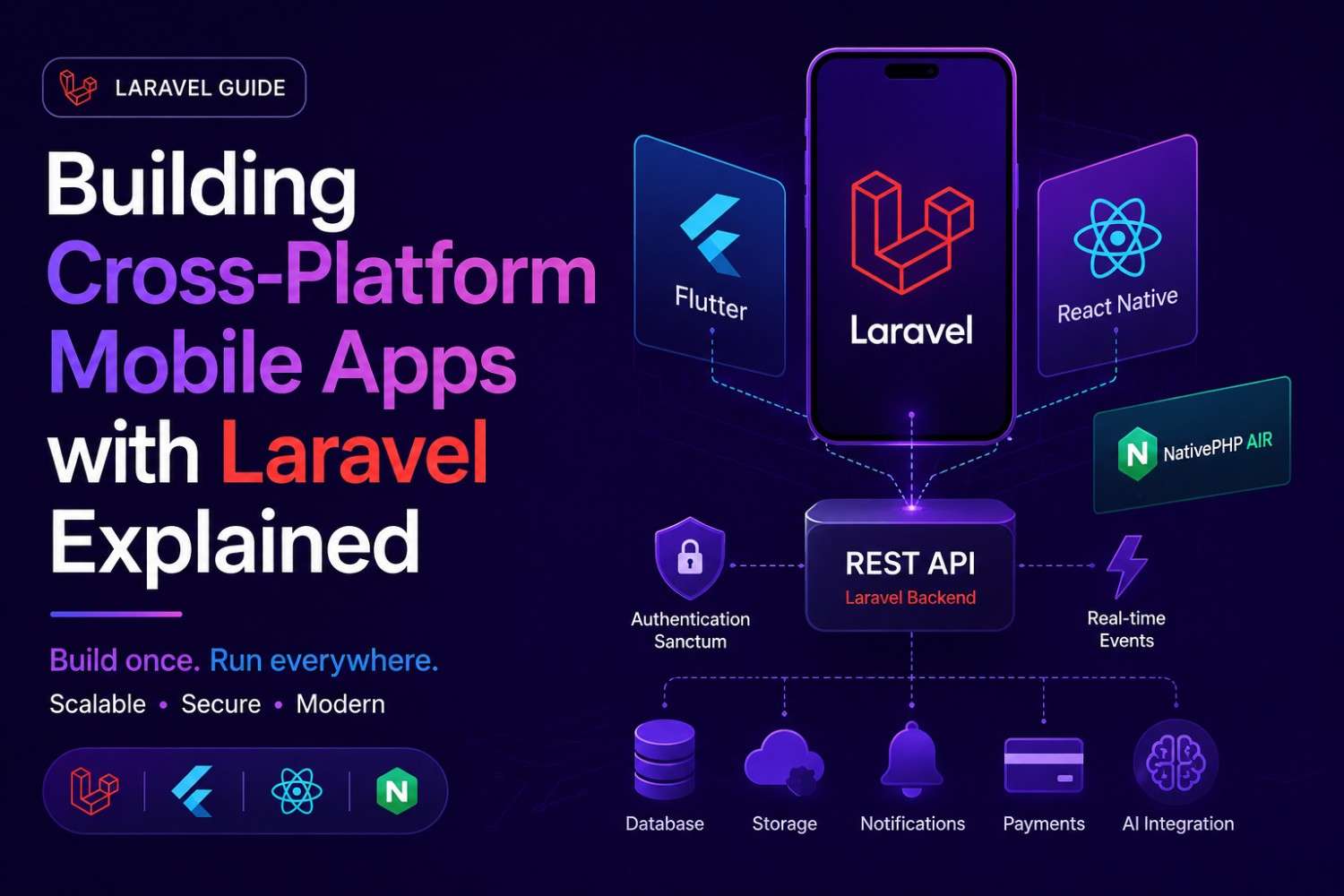

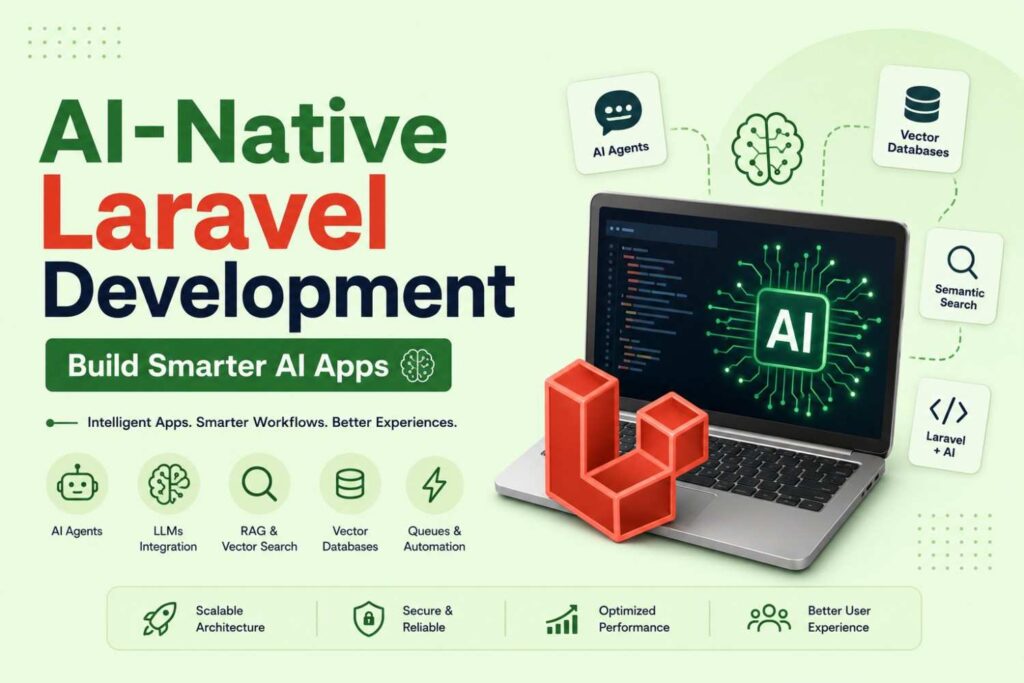
Laravel has rapidly become one of the best frameworks for AI-powered application development. Thanks to its elegant architecture, queues, events, caching, broadcasting, API capabilities, package ecosystem, and scalable infrastructure, Laravel enables developers to build sophisticated AI applications that compete with enterprise solutions.
This guide explains everything you need to know about AI-native Laravel development, including architecture, AI agents, Retrieval-Augmented Generation (RAG), vector databases, LLM integration, security, deployment, performance optimization, and best practices.
What is AI-Native Development?
AI-native development refers to designing applications where Artificial Intelligence is embedded into the application’s architecture from the beginning.
Instead of adding AI features later, the application’s workflows, database design, APIs, business logic, and user experience are built around machine intelligence.
Examples include:
- AI customer support
- AI coding assistants
- AI document processing
- AI search engines
- AI recommendation systems
- AI workflow automation
- AI sales assistants
- AI content generation
- AI legal document analysis
- AI healthcare assistants
Unlike traditional software, AI-native systems continuously learn, retrieve context, and generate intelligent responses.
AI-Native vs Traditional AI Integration
| Traditional AI Integration | AI-Native Development |
|---|---|
| AI added later | AI designed from day one |
| Static workflows | Intelligent workflows |
| Rule-based automation | LLM reasoning |
| Keyword search | Semantic search |
| Simple chatbot | AI agents |
| Basic API calls | Full AI architecture |
| Limited personalization | Context-aware experiences |
Why Laravel is Perfect for AI-Native Applications
Laravel already provides many enterprise features needed by AI systems.
Elegant API Development
Laravel API Resources make it easy to expose AI endpoints.
Example:
POST /api/chat

POST /api/generate

POST /api/embedding

POST /api/agent

POST /api/search
Powerful Queue System
AI requests may take several seconds.
Laravel Queues allow developers to:
- Generate embeddings
- Process PDFs
- Summarize documents
- Run AI agents
- Generate images
- Process videos
without blocking users.
Supported drivers include:
- Redis
- Amazon SQS
- Database
- Beanstalkd
Event-Driven Architecture
Laravel Events make AI systems modular.
Example workflow:
User uploads PDF
↓
DocumentProcessed Event
↓
EmbeddingGenerated Event
↓
VectorDatabaseUpdated Event
↓
AI Ready
Cache System
AI APIs are expensive.
Laravel Cache helps store:
- LLM responses
- embeddings
- semantic search
- prompts
- conversation history
Supported drivers:
- Redis
- Memcached
- DynamoDB
- Database
Core Components of AI-Native Laravel
A modern AI Laravel application typically contains:
Frontend

↓

Laravel

↓

AI Service Layer

↓

LLM Provider

↓

Embedding Model

↓

Vector Database

↓

Knowledge Base

↓

External APIs

↓

Monitoring
Choosing the Right Large Language Model (LLM)
Popular LLM providers include:
OpenAI
Best for:
- GPT chat
- Function calling
- Reasoning
- Content generation
Anthropic Claude
Known for:
- Long context windows
- Enterprise safety
- Coding
- Document analysis
Google Gemini
Strong for:
- Multimodal AI
- Image understanding
- Long-context processing
Open Source Models
Examples:
- Llama
- Mistral
- DeepSeek
- Qwen
Benefits:
- Lower cost
- Self-hosting
- Privacy
- Custom fine-tuning
AI Agents in Laravel
An AI agent performs tasks autonomously.
Example:
Customer asks:
“Find all unpaid invoices and send reminders.”
The agent:
- searches database
- retrieves invoices
- generates emails
- sends reminders
- updates CRM
- logs actions
Laravel handles:
- Jobs
- Queues
- Notifications
- Events
- Scheduling
Retrieval-Augmented Generation (RAG)
RAG allows AI to answer questions using your own data.
Instead of relying only on model training, RAG retrieves relevant information before generating responses.
Workflow:
User Question

↓

Embedding

↓

Vector Search

↓

Relevant Documents

↓

LLM

↓

Answer
Benefits:
- Higher accuracy
- Lower hallucination
- Company knowledge
- Private documents
- Fresh information
Understanding Embeddings
Embeddings convert text into numerical vectors.
Example:
Laravel Queue

↓

[0.12, 0.44, 0.98...]
Similar content produces similar vectors.
Embeddings power:
- semantic search
- recommendations
- RAG
- AI memory
- duplicate detection
Vector Databases
Traditional SQL databases cannot efficiently search embeddings.
Popular vector databases:
Pinecone
Cloud-native vector search.
Weaviate
Open-source vector database.
Qdrant
Excellent performance.
Milvus
Enterprise-scale vector search.
pgvector
PostgreSQL extension supporting vectors.
Ideal for Laravel applications already using PostgreSQL.
AI Memory
AI-native apps remember users.
Memory includes:
- previous chats
- preferences
- uploaded documents
- projects
- conversation history
- goals
Laravel stores memory using:
- MySQL
- PostgreSQL
- Redis
- Vector databases
Streaming AI Responses
Instead of waiting 30 seconds, responses stream word-by-word.
Laravel supports streaming using:
- Server-Sent Events (SSE)
- WebSockets
- Laravel Reverb
- Broadcasting
Benefits:
- Better UX
- Faster perceived performance
Laravel Queues for AI
Never process AI synchronously.
Instead:
User Upload

↓

Queue Job

↓

OCR

↓

Embedding

↓

Store Vector

↓

Notify User
Queue workers improve scalability.
Multi-Agent AI Systems
Large applications use multiple agents.
Examples:
Research Agent
↓
Planning Agent
↓
Coding Agent
↓
Testing Agent
↓
Documentation Agent
Laravel orchestrates communication through queues and events.
AI Security
Protect AI applications by implementing:
Input validation
Prevent prompt injection.
Output filtering
Detect harmful responses.
Authentication
Use:
- Laravel Sanctum
- OAuth
- JWT
Authorization
Implement Laravel Policies and Gates.
Rate limiting
Protect expensive AI endpoints.
Cost Optimization
LLMs can become expensive.
Reduce costs by:
- Response caching
- Prompt optimization
- Smaller models
- Background processing
- Token monitoring
- Context compression
- Batch embeddings
Performance Optimization
Optimize AI applications using:
- Redis caching
- Horizon queues
- Octane
- Lazy collections
- Pagination
- Database indexing
- CDN
- HTTP caching
AI Testing
Test:
- prompts
- API failures
- hallucinations
- response quality
- latency
- edge cases
- authorization
Laravel PHPUnit tests should cover AI workflows.
Laravel Packages for AI Development
Popular packages and tools include:
- Prism PHP
- OpenAI PHP SDK
- Laravel Horizon
- Laravel Reverb
- Laravel Pulse
- Laravel Scout
- Laravel Octane
- Laravel Sanctum
- Spatie packages
- Livewire
- Inertia.js
Best Practices for AI-Native Laravel Development
- Design AI as a core architectural component, not an add-on.
- Keep prompts version-controlled and reusable.
- Separate AI logic into dedicated service classes.
- Use queues for all long-running AI tasks.
- Implement RAG instead of relying solely on LLM memory.
- Store embeddings in a vector database.
- Cache AI responses where appropriate.
- Monitor token usage and API costs.
- Secure endpoints with authentication, authorization, and rate limiting.
- Log prompts and responses for debugging while protecting sensitive user data.
- Build fallback mechanisms for AI provider outages.
- Continuously evaluate model performance and update prompts as models evolve.
Final Thoughts
AI-native Laravel development is reshaping how modern web applications are designed. Rather than treating artificial intelligence as an optional feature, developers can build systems where AI powers search, automation, decision-making, content generation, and personalized user experiences from the ground up.
Laravel’s expressive syntax, mature ecosystem, and enterprise-ready tooling including queues, events, caching, authentication, real-time broadcasting, and scalable APIs—make it an excellent framework for intelligent application development. By combining Laravel with LLMs, vector databases, RAG, AI agents, and strong security and observability practices, organizations can create scalable AI products that are ready for the next generation of software.