
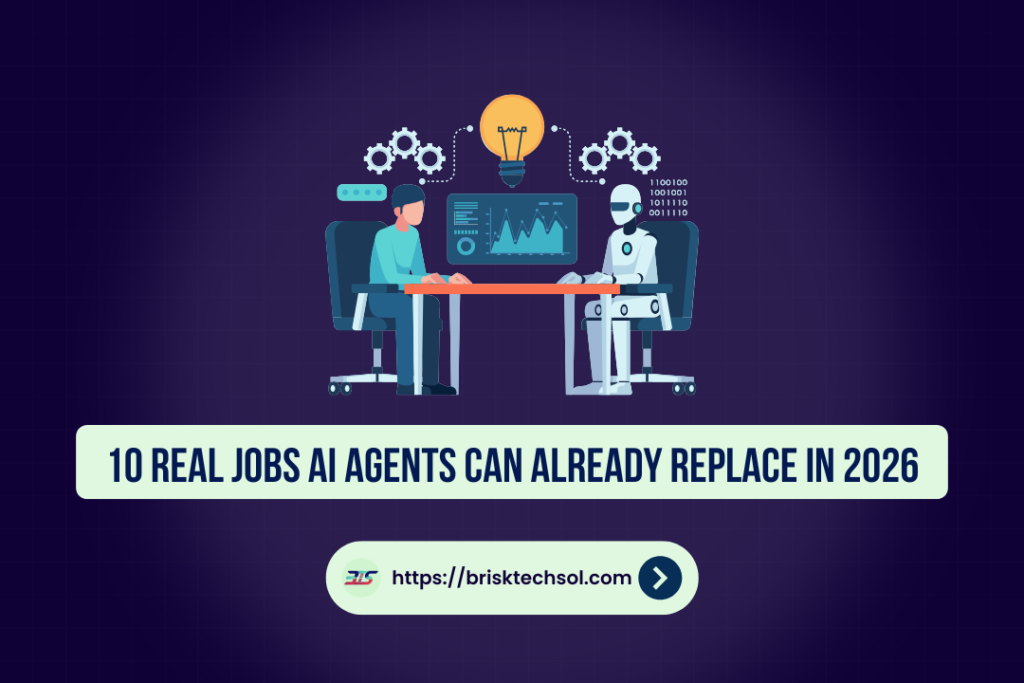
In 2026, AI agents are no longer just “assistants” that help humans work faster they are increasingly becoming autonomous operators capable of executing full job functions with minimal supervision. From customer service to data analysis, AI systems powered by advances from companies like OpenAI, Google DeepMind, and Microsoft are reshaping the labor market in real time.
This doesn’t mean all jobs disappear overnight. Instead, it means task-level automation is evolving into role-level replacement, especially for repetitive, structured, and digital-first work.
Below are 10 real jobs AI agents can already replace in 2026, based on current capabilities in automation, reasoning, and tool-using AI systems.
1. Customer Support Representatives (Tier 1 & Tier 2)
AI agents now handle most frontline customer queries across chat, email, and even voice.
Modern systems can:
- Resolve billing issues
- Reset accounts and passwords
- Handle refunds and cancellations
- Escalate only edge cases
Unlike old chatbots, AI agents now understand intent, context, and emotional tone, making them capable of replacing large portions of support teams.
2. Data Entry Clerks
This is one of the earliest and most complete AI replacements.
AI agents can:
- Extract data from PDFs, emails, and forms
- Validate and clean datasets
- Transfer data between systems (CRM, ERP, spreadsheets)
- Detect inconsistencies automatically
What once required manual typing is now fully automated through document AI + agent workflows.
3. Basic Content Writers (SEO & Blog Drafting)
AI agents now generate:
- SEO articles
- Product descriptions
- Landing page copy
- Meta descriptions and ad copy
While high-end branding still benefits from human creativity, commodity content writing has largely been automated, especially in bulk publishing environments.
4. Virtual Assistants / Administrative Coordinators
AI agents are now capable of managing full administrative pipelines:
- Scheduling meetings across time zones
- Managing inboxes
- Drafting emails and replies
- Preparing summaries of meetings and documents
In many startups, AI assistants are already replacing entry-level admin roles entirely.
5. Bookkeeping Assistants
With integration into financial tools, AI agents can:
- Categorize transactions
- Reconcile accounts
- Generate invoices
- Track expenses in real time
Human accountants are still required for compliance and strategy, but routine bookkeeping is increasingly automated.
6. Sales Development Representatives (SDRs)
AI SDR agents now:
- Generate leads from databases
- Personalize outreach emails
- Follow up automatically
- Score lead quality using behavioral signals
Instead of manually prospecting, sales teams now supervise AI-driven pipelines that operate 24/7.
7. Translation and Localization Workers (Basic Level)
AI translation systems now handle:
- Website localization
- Document translation
- Subtitles and captions
- Multi-language customer support
Human translators are still needed for legal, literary, and cultural nuance but basic translation work is largely automated.
8. Social Media Managers (Entry Level)
AI agents can:
- Generate posts and captions
- Schedule content calendars
- Analyze engagement metrics
- Respond to common comments
Many small businesses now run “autopilot” social media systems with minimal human involvement.
9. Market Research Analysts (Basic Reporting Level)
AI agents can already:
- Scrape competitor data
- Summarize industry trends
- Generate SWOT analyses
- Build reports from real-time data
What used to take days of manual research can now be done in minutes using agent-based research systems.
10. QA Testers (Manual Testing)
AI agents in software development environments now:
- Simulate user behavior
- Detect UI bugs
- Run regression tests automatically
- Report issues with screenshots and logs
Manual QA roles are shrinking as continuous AI-driven testing becomes standard in DevOps pipelines.
What This Really Means for the Workforce
The key shift in 2026 is not “job loss” but job compression:
- 5-person teams can now do the work of 20
- Junior roles are being replaced faster than senior roles
- Supervision, strategy, and creative decision-making remain human-heavy
The biggest impact is on repetitive digital labor, not complex judgment-based professions.
Final Thoughts
AI agents are not just tools anymore they are becoming digital workers inside companies. Organizations adopting these systems early are gaining massive efficiency advantages, while traditional workflows are rapidly being phased out.
The future of work is not fully automated but it is undeniably agent-assisted, agent-supervised, and increasingly agent-executed.