
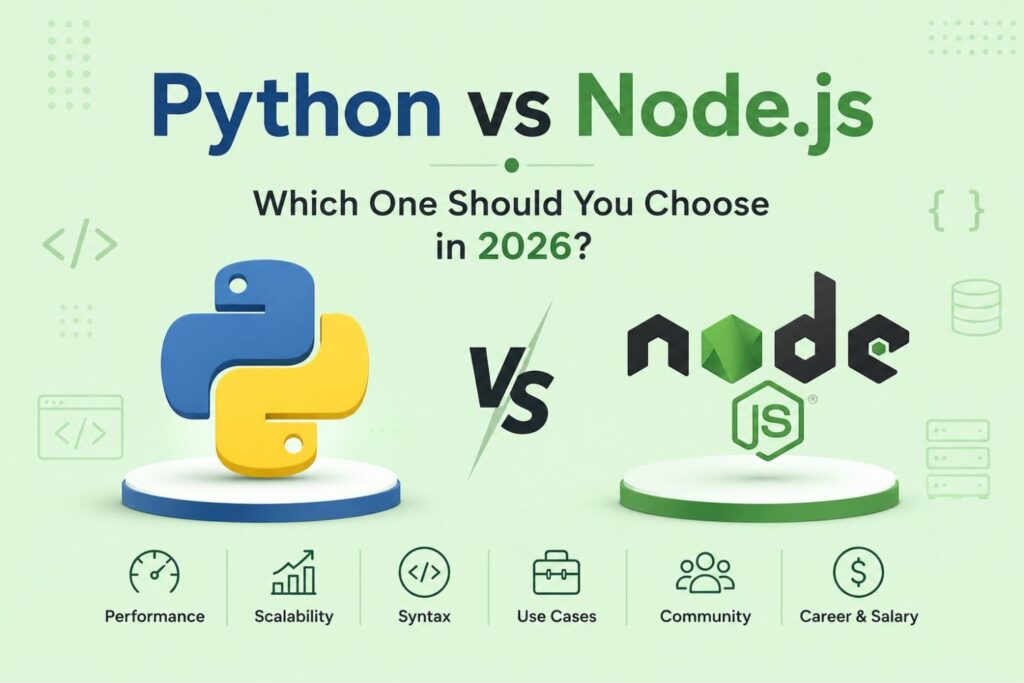
If you’re planning to become a software developer, build a web application, create APIs, or develop an AI-powered product, you’ve probably asked one important question:
Should I learn Python or Node.js?
The answer isn’t as simple as choosing the “better” technology because both solve different problems exceptionally well.
Python has dominated fields like artificial intelligence, machine learning, automation, and data science for years. Meanwhile, Node.js has become one of the most popular choices for building fast, scalable web applications and real-time systems.
In this detailed comparison, we’ll explore every major difference between Python and Node.js, including performance, architecture, syntax, scalability, frameworks, job opportunities, community support, and real-world use cases.
By the end of this guide, you’ll know exactly which one fits your goals.
What is Python?
Python is a high-level, interpreted programming language created by Guido van Rossum and first released in 1991.
Its simple syntax makes it one of the easiest languages to learn while remaining powerful enough for enterprise software, scientific computing, automation, cybersecurity, AI, and backend web development.
Today, Python powers millions of applications worldwide and is widely used by companies like:
- Netflix
- Spotify
- Dropbox
- NASA
- Instagram (backend services)
Python emphasizes readability, making code easier to maintain.
What is Node.js?
Node.js is not a programming language.
It is an open-source JavaScript runtime environment built on Google’s V8 JavaScript Engine that allows developers to run JavaScript outside the browser.
Created by Ryan Dahl in 2009, Node.js transformed backend development by enabling JavaScript to be used on both the frontend and backend.
Node.js excels at:
- Real-time applications
- REST APIs
- Streaming services
- Chat applications
- Multiplayer games
- Microservices
- Serverless computing
Major companies using Node.js include:
- Netflix
- PayPal
- Uber
- Walmart
- eBay
- Trello
Python vs Node.js at a Glance
| Feature | Python | Node.js |
|---|---|---|
| Type | Programming Language | JavaScript Runtime |
| Syntax | Simple and readable | JavaScript-based |
| Performance | Moderate | Very Fast |
| Concurrency | Multi-threading & AsyncIO | Event Loop & Non-blocking I/O |
| Best For | AI, ML, Automation, Data Science | APIs, Real-time Apps, Web Servers |
| Learning Curve | Beginner Friendly | Moderate |
| Package Manager | pip | npm |
| Community | Massive | Massive |
| Scalability | Excellent | Excellent |
| Speed | Slower | Faster |
Python vs Node.js Performance
Performance is often the deciding factor when selecting backend technology.
Node.js Performance
Node.js uses:
- Single-threaded Event Loop
- Non-blocking I/O
- Asynchronous programming
This architecture allows Node.js to handle thousands of simultaneous connections efficiently.
It performs exceptionally well for:
- Chat apps
- Video streaming
- Gaming servers
- REST APIs
- WebSockets
Node.js typically outperforms Python in I/O-intensive applications.
Python Performance
Python is an interpreted language.
Although slower than compiled languages, its performance is more than sufficient for most applications.
Python shines in:
- Scientific computing
- Machine learning
- Data processing
Libraries such as:
- NumPy
- Pandas
- TensorFlow
execute optimized C/C++ code behind the scenes, making Python surprisingly fast for computational workloads.
Winner
Node.js wins for speed and concurrent requests.
Architecture Comparison
Python
Python supports multiple programming paradigms:
- Object-Oriented Programming (OOP)
- Functional Programming
- Procedural Programming
It also supports:
- Multi-threading
- Multi-processing
- AsyncIO
Node.js
Node.js relies on:
- Event-driven architecture
- Event Loop
- Non-blocking asynchronous I/O
Instead of creating one thread per request, Node.js efficiently manages thousands of requests using callbacks, promises, and async/await.
Syntax Comparison
Python Example
def greet(name):
    return f"Hello {name}"

print(greet("John"))
Simple, readable, and beginner-friendly.
Node.js Example
function greet(name){
    return `Hello ${name}`;
}

console.log(greet("John"));
Developers already familiar with JavaScript will find Node.js very natural.
Learning Curve
Python consistently ranks as one of the easiest programming languages to learn.
Reasons include:
- Clean syntax
- Minimal boilerplate
- Large educational ecosystem
- Excellent documentation
Node.js requires understanding:
- JavaScript
- Asynchronous programming
- Promises
- Callbacks
- Event Loop
- npm ecosystem
Winner
Python is easier for beginners.
Scalability
Both technologies scale well but in different ways.
Node.js
Designed specifically for scalable network applications.
Ideal for:
- Microservices
- Load balancing
- Real-time communication
- Cloud-native applications
Python
Scales effectively using:
- Multiple worker processes
- Async frameworks
- Distributed computing
Popular cloud platforms support Python exceptionally well.
Web Development
Python Frameworks
Popular frameworks include:
- Django
- Flask
- FastAPI
- Pyramid
- Tornado
FastAPI has become particularly popular for modern API development because of its exceptional performance and automatic documentation generation.
Node.js Frameworks
Popular frameworks include:
- Express.js
- NestJS
- Fastify
- Koa
- Hapi
Express remains one of the most widely adopted backend frameworks.
Winner
For web applications:
- Django excels for large applications.
- Express offers unmatched flexibility.
- FastAPI is excellent for APIs.
API Development
Node.js excels at:
- REST APIs
- GraphQL APIs
- Real-time APIs
- WebSockets
Python excels with:
- FastAPI
- Django REST Framework
- Flask APIs
Both are excellent choices.
AI and Machine Learning
This category isn’t even close.
Python dominates because of its ecosystem:
- TensorFlow
- PyTorch
- Keras
- Scikit-learn
- OpenCV
- NumPy
- Pandas
Most AI research is conducted using Python.
Winner
Python by a huge margin.
Data Science
Python is the industry standard.
Popular libraries include:
- Pandas
- NumPy
- Matplotlib
- Seaborn
- SciPy
Node.js has very limited adoption in this field.
Winner
Python.
Automation and Scripting
Python is famous for automation.
Examples:
- Web scraping
- File processing
- Task scheduling
- Browser automation
- DevOps scripting
- System administration
Libraries include:
- Selenium
- BeautifulSoup
- Requests
- Playwright
- Paramiko
Node.js can automate workflows but isn’t as widely adopted.
Real Time Applications
Node.js is built for:
- Live chat
- Messaging
- Multiplayer games
- Stock trading
- Collaboration tools
- Streaming
Its event-driven architecture makes it ideal.
Winner
Node.js.
Database Support
Both support virtually every major database.
Python
- PostgreSQL
- MySQL
- SQLite
- MongoDB
- Redis
- Oracle
Node.js
- MongoDB
- PostgreSQL
- MySQL
- Redis
- MariaDB
- SQL Server
Neither has a significant advantage.
Package Ecosystem
Python
Uses:
pipContains over 500,000+ packages.
Node.js
Uses:
npmThe largest software package registry in the world with millions of packages available.
Winner
Node.js has the largest ecosystem.
Community Support
Both have enormous communities.
Python benefits from:
- Scientific community
- Academic institutions
- AI researchers
Node.js benefits from:
- JavaScript developers
- Open-source contributors
- Web developers
Finding tutorials is easy for either platform.
Security
Security depends more on coding practices than the language itself.
Python offers:
- Django’s built-in security features
- Mature authentication libraries
Node.js offers:
- Helmet
- JWT libraries
- OWASP-focused middleware
Keeping dependencies updated is essential in both ecosystems.
Deployment
Python commonly deploys using:
- Gunicorn
- uWSGI
- Docker
- Kubernetes
Node.js commonly deploys using:
- PM2
- Docker
- Kubernetes
- Serverless platforms
Both integrate well with cloud providers.
Memory Usage
Node.js generally consumes less memory for high-concurrency applications.
Python often requires more memory because of multiple worker processes.
Development Speed
Python usually enables faster development because of:
- Less code
- Cleaner syntax
- Rich libraries
Node.js development becomes very efficient for teams already using JavaScript.
Job Market in 2026
Python developers remain in extremely high demand in:
- AI
- Data Science
- Machine Learning
- Cybersecurity
- Automation
- Cloud Computing
Node.js developers continue seeing strong demand for:
- Backend Development
- Full Stack Development
- SaaS
- Enterprise Applications
- FinTech
- Real-time Systems
Both offer excellent career opportunities.
Salary Comparison
Average salaries vary by country and experience.
Generally:
Python developers command slightly higher salaries in AI and machine learning roles.
Node.js developers are highly compensated in startup and enterprise backend positions.
Both rank among the highest-paying programming careers.
Pros and Cons
Python Pros
- Easy to learn
- Excellent readability
- Huge AI ecosystem
- Great documentation
- Massive community
- Strong automation capabilities
Python Cons
- Slower execution
- Higher memory usage
- Not ideal for high-concurrency workloads
Node.js Pros
- Extremely fast
- Excellent scalability
- JavaScript everywhere
- Massive npm ecosystem
- Perfect for APIs
- Great for real-time applications
Node.js Cons
- Callback complexity (though mitigated with async/await)
- Less suitable for CPU-intensive tasks
- Dependency management can become challenging
When Should You Choose Python?
Choose Python if you’re building:
- AI applications
- Machine learning models
- Data science projects
- Automation tools
- Cybersecurity tools
- Scientific software
- Web scraping projects
- Enterprise web applications with Django
When Should You Choose Node.js?
Choose Node.js if you’re developing:
- Real-time chat apps
- Streaming platforms
- REST APIs
- GraphQL APIs
- SaaS platforms
- Multiplayer games
- Social media applications
- Microservices
- Collaborative tools
Can You Use Python and Node.js Together?
Absolutely.
Many modern applications combine both technologies.
For example:
- Node.js handles the frontend backend, API gateway, and real-time communication.
- Python powers AI models, recommendation engines, analytics, or background data processing.
These services communicate through REST APIs, GraphQL, gRPC, or message queues such as RabbitMQ and Apache Kafka. This hybrid architecture allows each technology to play to its strengths.