
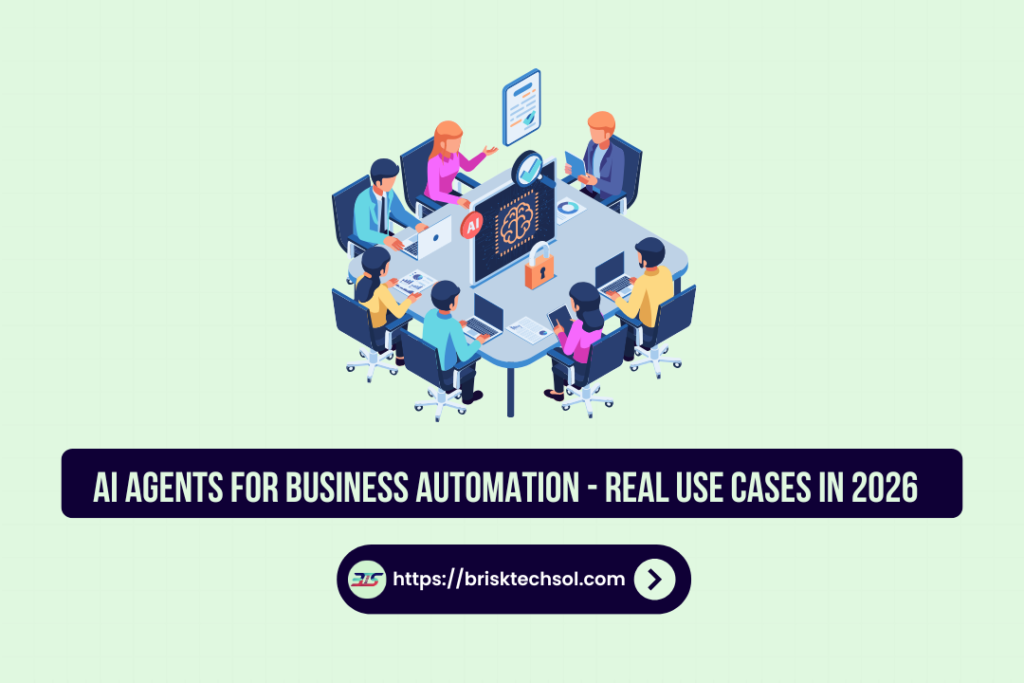
In 2026, AI agents have moved far beyond simple chatbots and workflow scripts. They are now autonomous business systems capable of planning tasks, executing actions across tools, and optimizing operations without constant human input.
Powered by advancements from companies like OpenAI, Microsoft, and Google DeepMind, AI agents are now deeply embedded into modern business infrastructure from marketing and sales to finance and operations.
What Are AI Agents in Business Context?
AI agents are not traditional software tools. They are goal-driven systems that can:
- Understand business objectives
- Break them into tasks
- Use tools (CRM, email, spreadsheets, APIs)
- Execute workflows independently
- Learn from outcomes and improve performance
Unlike static automation, AI agents behave more like digital employees with decision-making ability.
1. Customer Support Automation (End-to-End Resolution Systems)
One of the most mature use cases in 2026 is fully autonomous customer support pipelines.
How AI agents are used:
- Handle tickets across email, chat, WhatsApp, and voice
- Diagnose customer issues using account data
- Execute refunds, replacements, or troubleshooting steps
- Escalate only complex edge cases
Business impact:
- 60–80% reduction in human support workload
- 24/7 global support without staffing costs
- Faster resolution times and higher satisfaction scores
These systems often integrate with CRMs like Salesforce and internal knowledge bases to deliver accurate responses.
2. AI-Powered Sales Automation (Lead-to-Close Pipelines)
Sales teams are now heavily supported by autonomous AI SDR agents.
What AI agents do:
- Identify leads from databases and web signals
- Personalize outreach emails and follow-ups
- Score leads based on behavior and intent
- Schedule meetings automatically
Instead of manual prospecting, AI systems continuously run always-on sales pipelines.
Result:
Sales teams shift from cold outreach to closing high-quality, AI-qualified leads.
3. Marketing Campaign Automation (Full Funnel Execution)
Marketing has become one of the most AI-automated business functions.
AI agents now handle:
- Content generation (blogs, ads, landing pages)
- A/B testing of campaigns
- Budget allocation across channels
- Audience segmentation
- Performance optimization in real time
Platforms powered by ecosystems like Meta and Google Ads increasingly rely on AI-driven campaign optimization.
Impact:
Marketing is no longer campaign-based it is continuous optimization-driven growth engineering.
4. Finance & Bookkeeping Automation
AI agents now act as autonomous financial assistants.
Core functions:
- Invoice generation and processing
- Expense categorization
- Bank reconciliation
- Fraud detection alerts
- Monthly financial reporting
Business benefit:
Small and mid-sized companies no longer need large bookkeeping teams for routine financial tasks.
However, strategic financial planning still requires human oversight.
5. HR & Recruitment Automation
Hiring processes have become significantly AI-driven.
AI agent capabilities:
- Resume screening and ranking
- Candidate outreach and scheduling
- Initial interview assessments
- Job description optimization
- Employee onboarding workflows
Recruitment teams now focus on final decision-making rather than manual filtering.
6. IT Operations & DevOps Automation
AI agents are increasingly embedded in software infrastructure.
What they manage:
- Server monitoring and auto-scaling
- Bug detection and resolution suggestions
- Automated deployment pipelines
- Incident response workflows
In advanced setups, AI agents can even roll back deployments when anomalies are detected.
This is heavily used in cloud ecosystems supported by Amazon Web Services.
7. Data Analysis & Business Intelligence
AI agents have transformed how companies interact with data.
Traditional BI vs AI agents:
Instead of dashboards that require human interpretation, AI agents now:
- Ask clarifying questions
- Generate insights automatically
- Detect trends and anomalies
- Produce executive-ready reports
8. E-commerce Operations Automation
Online businesses now rely heavily on AI agent ecosystems.
Use cases:
- Inventory forecasting
- Dynamic pricing optimization
- Product listing generation
- Customer recommendation engines
- Order tracking and logistics coordination
E-commerce platforms now run with minimal human operational input, especially in backend workflows.
9. Legal & Compliance Automation (Document-Level Tasks)
AI agents are widely used for structured legal workflows.
They assist with:
- Contract drafting
- Document review and summarization
- Compliance checks
- Risk flagging in agreements
While final legal approval remains human-controlled, AI significantly reduces manual workload in document-heavy environments.
10. Internal Operations & Workflow Coordination
One of the fastest-growing areas in 2026 is AI orchestration of internal business operations.
AI agents manage:
- Meeting scheduling across departments
- Task assignment in project management tools
- Internal reporting and reminders
- Cross-team coordination workflows
Instead of managers micromanaging tasks, AI agents act as operational coordinators inside organizations.
Why AI Agents Are So Effective in 2026
Several technological shifts have enabled this transformation:
1. Tool-Using AI Systems
Modern AI can interact with APIs, CRMs, and databases directly.
2. Multimodal Understanding
Agents now process text, images, audio, and structured data together.
3. Persistent Memory Systems
They remember context across workflows and sessions.
4. Autonomous Decision Loops
They don’t just respond they act, evaluate, and refine outcomes.
Key Benefits for Businesses
Companies adopting AI agent systems report:
- Lower operational costs
- Faster execution of workflows
- Reduced human error
- 24/7 productivity
- Scalable business processes without linear hiring
Challenges Businesses Must Manage
Despite their power, AI agents introduce new risks:
- Data privacy and compliance concerns
- Over-automation of critical decisions
- Integration complexity with legacy systems
- Need for human oversight in edge cases
The most successful companies use a hybrid model: AI execution + human supervision.
Final Thoughts
In 2026, AI agents are no longer experimental they are core business infrastructure.
From customer support to financial operations, they are reshaping how companies operate at every level.
Businesses that embrace AI agents early are building leaner, faster, and more adaptive organizations, while those that delay adoption risk falling behind in operational efficiency.